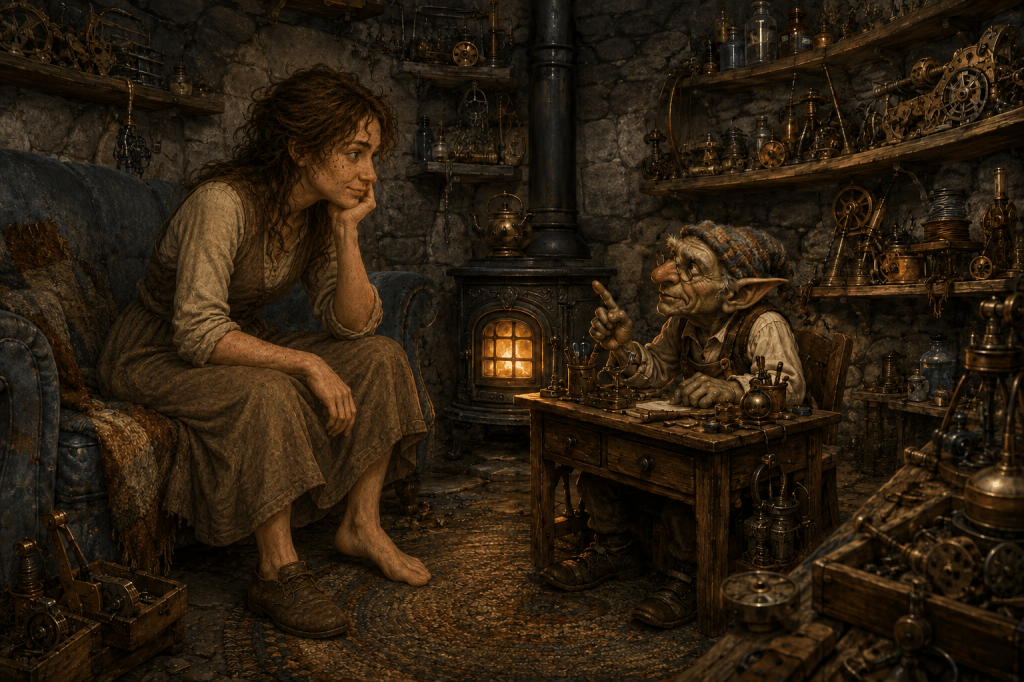
Questline began with a question that probably says a great deal about how my mind works: What if the entire fantasy questing industry was largely staged?
Not fake, exactly. There are still monsters, magic, danger, and all the other things that make a respectable fantasy world hazardous to live in. But what if the quests themselves had become an industry? What if aspiring heroes attended an academy, learned the proper techniques for looking heroic, and entered a system filled with sponsors, staged encounters, carefully managed danger, and people whose livelihoods depended upon keeping the whole thing running?
Once I had that idea, the world started building itself through increasingly strange applications of logic.
That has been one of the most enjoyable parts of writing Questline. The setting is ridiculous, but it needs to be ridiculous in a way that makes sense. Every absurdity creates a logical gap, and every logical gap demands an explanation. Those explanations usually create two or three more absurdities, which then need explanations of their own.
It is a wonderfully ridiculous cycle.
The magic has developed in much the same way. Rather than beginning with a neatly organized list of spells, I’ve enjoyed building different magical systems around internal qualities and finding ways for those qualities to create external effects. Emotions, intentions, connections, and patterns of behavior can all become part of how magic works. That gives the story room for magical solutions that feel surprising while still following the strange rules of the world.
The goal has never been to make the magic explain away every problem. It is more fun when it explains why the problem is even stranger than everyone initially realized.
As the ideas grew, so did the manuscript. What I originally expected to be a story somewhere around 100,000 words eventually became a roughly 157,000-word novel. Apparently, giving me a world full of heroes, staged quests, questionable institutions, and several overlapping forms of magic was not an effective strategy for encouraging brevity.
One major step in the process was publishing the story serially on Royal Road.
Royal Road is a platform where authors can release stories chapter by chapter, allowing readers to follow along while a book is still being written or prepared for wider publication. My main reason for using it was exposure. Publishing a novel—especially as an independent author—comes with the difficult question of how anyone is supposed to discover that the book exists. Royal Road gave Questline the opportunity to begin finding readers before its Amazon release.
It also let me see people responding to the story as it unfolded. There is something uniquely enjoyable and mildly terrifying about releasing chapters while readers speculate about where everything is going. Their comments helped me see which jokes landed, which characters connected with people, and which mysteries were doing their jobs.
Serializing the story also gave me a regular publishing schedule and a very concrete reason to keep moving. A distant deadline can sometimes feel theoretical. A chapter that needs to go live soon feels considerably less theoretical.
Another major change came when I began using dictation more seriously.
I dabbled with dictation a few times in January, but did not find a stride for it until late February, when the birth of our fourth child meant a total destruction of previous time structures. Dictation had to work at that point. Instead of trying to compose every sentence at the keyboard, I could work from an outline, speak the scene aloud, and then turn the resulting transcript into finished prose.
The raw transcripts are not pretty. They contain repetitions, abandoned thoughts, strange transcription errors, and sentences that begin confidently before wandering into the woods and dying there. But they give me something extremely valuable: momentum.
Dictation made it easier to get the substance of a scene onto the page without stopping every few words to polish it. I could capture the dialogue, humor, emotional turns, and general shape of the scene first. Then I could return to it and do the more careful work of turning that material into prose.
That change dramatically increased how much I could produce. It also helped me separate drafting from editing. When drafting, I can concentrate on discovering the scene. When editing, I can concentrate on making it readable and pretending it emerged that way the first time.
Now that the Royal Road serialization is complete, Questline is entering the final stretch before its Amazon launch, which I’m expecting within the next month or so.
The Amazon edition will receive a more detailed polishing pass than the serialized version. I’ve already made adjustments throughout the process, but this final stage will let me look at the book as one complete novel rather than a succession of individual chapter releases. I’ll be tightening the prose, correcting lingering problems, and making sure all the moving pieces fit together as cleanly as a book built around institutionalized heroic nonsense reasonably can.
The Amazon edition will also include an exclusive epilogue that was not part of the Royal Road release. I wanted the serialized version to reach a satisfying stopping point while still giving the published edition something meaningful of its own. The epilogue adds one final piece to the story and helps point toward what lies ahead for the series.
Writing Questline has involved outlining, improvising, dictating, editing, publishing chapter by chapter, and inventing increasingly elaborate magical explanations for increasingly peculiar problems. It has grown well beyond my original expectations, both in length and in the complexity of its world.
Fortunately, “well beyond my original expectations” is a fairly appropriate condition for a book about an industry that attempts to organize fantasy adventures and is shocked when things refuse to remain organized.


Leave a comment